From Data to Application: MEDAM and the Transfer of AI in Additive Manufacturing
Additive manufacturing has long been considered a key technology in the field of medical engineering. It has significant potential, from creating patient-specific components to offering new approaches to production. However, there is a crucial challenge between technical feasibility and industrial-grade application: transferring it into real-world processes.
This is precisely where the MEDAM research project steps in. Chimaera contributes its expertise in AI-supported image processing, structured annotation, and application-oriented software development to this effort.
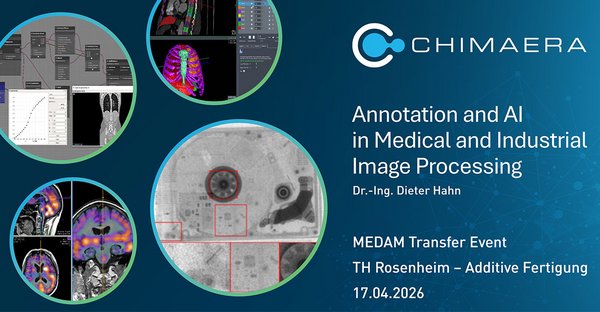
At the MEDAM transfer event held at Rosenheim Technical University of Applied Sciences, our CEO, Dr.-Ing. Dieter Hahn, discussed key success factors for using AI in medical and industrial image processing in his talk, "Annotation and AI in Medical and Industrial Image Processing." The subsequent discussion revealed that the perspectives of these two fields are more closely connected than they initially appear.
AI Starts with Data
One of the central themes of the talk was the role of data. In practice, AI projects rarely fail because the models are not complex enough; rather, they fail because the data foundation is not strong enough.
High-quality annotations are more than just a preparatory step. They are the basis for reliable results. In medical and industrial image processing especially, data quality determines whether a model delivers robust insights or only works under laboratory conditions.
For Chimaera, this is a core principle. We don't think of AI as an isolated modeling problem; rather, we think of it as a process that begins with data structure.
From Detection to Decision
The goal of industrial image processing is no longer just to capture images. The real challenge is converting image data into reliable information for making concrete decisions.
Typical applications include detecting objects, defects, and anomalies; segmenting and classifying individual elements; and extracting shape parameters, geometries, and object dimensions. Additional tasks include noise reduction and artifact suppression.
This plays a central role in additive manufacturing. Component quality, material behavior, and process stability are closely interconnected. Therefore, image processing becomes a strategic tool for not only analysis but also understanding and controlling processes.
Technology Needs Context
Another important point from Dieter Hahn’s presentation is that technology alone is not enough.
Successful AI applications emerge from the combination of technical systems, domain knowledge, process understanding, and interdisciplinary collaboration. Those looking to combine additive manufacturing with AI must understand the entire process, from data input to its application in the real world.
That is why Chimaera takes a holistic approach. We don't develop for isolated use cases, but rather for broader contexts, such as existing workflows, concrete requirements, and complex system landscapes.
Deployment Creates Value
A model may be technically impressive yet create no real value in day-to-day practice. This is often due to a lack of integration, not the model itself.
AI's real value is created in deployment, when systems are embedded into existing processes such as:
- quality assurance workflows,
- production environments,
- data-driven decision logic.
Seamless integration is therefore not the final step. It is a core success factor. AI applications can only deliver long-term value when they fit into existing workflows.
Standardization Enables Scale
Standardization is one often underestimated lever. Modular platforms and reusable interfaces improve development efficiency and create a foundation for scalability.
This is especially important in the transfer between research and industry. Standardized structures reduce friction, simplify collaboration, and create more robust, transferable solutions.
For Chimaera, standardization is a key building block for advancing AI applications sustainably as reliable infrastructure for recurring needs, rather than as one-off projects.
AI Is an Ongoing Process
Perhaps the most important takeaway from the talk: AI is never truly “finished.”
Models must be monitored, refined, and adapted to new data and changing requirements. This applies equally to medical and industrial image processing. Anyone who wants to use AI successfully needs not only technology, but also the willingness to iterate continuously.
MEDAM provides an example of how this transfer can work in practice: through exchange, interdisciplinary collaboration, and a consistent focus on real-world use cases.
Exchange Creates Perspective
The event in Rosenheim demonstrated the significant potential at the intersection of AI, image processing, and additive manufacturing. The exchange between research, industry, and practical application is not an add-on — it is the basis for lasting solutions.
Chimaera focuses its efforts precisely on this: combining technological expertise with a clear understanding of processes, data, and deployment. Only then does image processing create real value.
The future of additive manufacturing will be shaped not only by new materials or machines but also by the ability to intelligently use and translate data into concrete applications.