
MICCAI 2026 in Strasbourg: Surgical AI, On-Device Intelligence, and New Perspective
Every year, MICCAI serves as a meeting place for the international community focused on medical image computing and computer-assisted intervention. MICCAI 2026 in Strasbourg once again demonstrated how dynamically medical image processing, surgical AI, and intelligent assistance systems are evolving.
Dr. Dieter Hahn, CEO of Chimaera GmbH, was also in attendance – as a visitor, networking partner, and sponsor of the TIGER SQ-AI Challenge. The focus was on current developments in medical image and video processing, as well as on how artificial intelligence can be integrated safely and practically into clinical applications.
TIGER SQ-AI: Using AI to Assess Surgical Quality
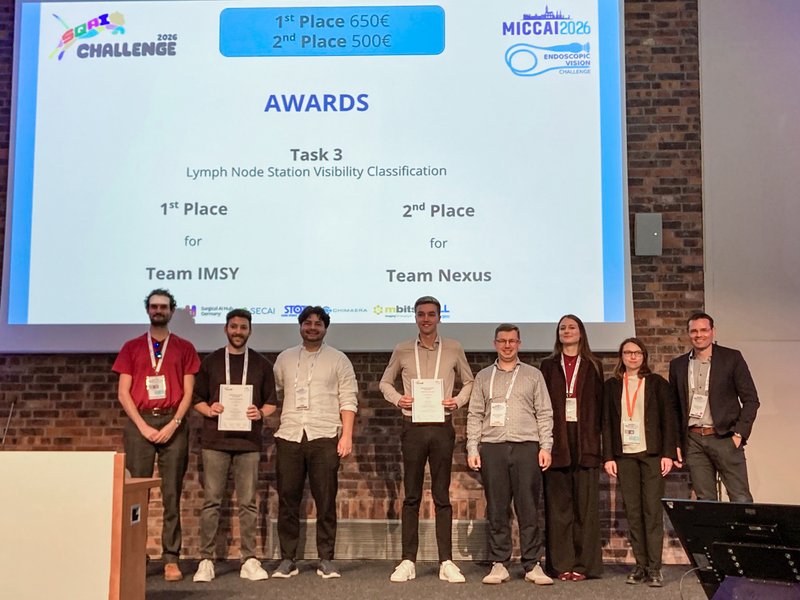
One of the highlights was the TIGER SQ-AI session held as part of EndoVis 2026. Chimaera GmbH supported the challenge as a sponsor. At its core was a demanding question: Can AI reliably assess surgical quality in minimally invasive procedures? To address this question, participating teams worked on two key tasks:
- Segmenting anatomical landmarks in surgical videos.
- Classifying thoracic lymph node stations during esophagectomies.
The challenge was based on a multicenter dataset of surgical videos from robotic and laparoscopic procedures. The recordings were annotated at the pixel level, providing a solid foundation for developing and comparing specialized AI methods. The results clearly demonstrate the potential of high-quality surgical data and well-defined tasks. We congratulate Team IMSY (Intelligent Medical Systems at DKFZ) on taking first place in all three tasks and Team NEXUS on achieving second place in the classification of lymph node stations.
As a project member of Surgical AI Hub Germany, Chimaera is particularly pleased to witness and support this progress. The challenge also highlights how closely data management, annotation, quality control, and AI development are interconnected. Without consistent and reliable workflows, it is difficult to use surgical video data efficiently for research and clinical applications.
On-Device Intelligence: Bringing AI to the Point of Care
Another important source of inspiration was the MICCAI keynote by Daniela Rus of MIT, titled “On-Device Intelligence for Healthcare.” Her vision is to bring AI closer to the point of care, creating new opportunities for personalized medicine, intelligent assistance systems, and advanced medical devices. This vision also raises a fundamental question: Who controls the data – and how is it processed?
On-device and on-premises AI can help process sensitive medical data within controlled environments. At the same time, these approaches make it possible to bring intelligent capabilities closer to clinical workflows and the point of care. However, realizing this potential requires more than powerful models. It also depends on secure data structures, clearly defined access permissions, suitable deployment solutions, and models adapted to the specific requirements of the data, workflow, and hardware.
This is precisely where Chimaera operates—with solutions for data management, AI-assisted annotation, and AI model deployment, as well as customized AI development services.
Networking and Lasting Connections
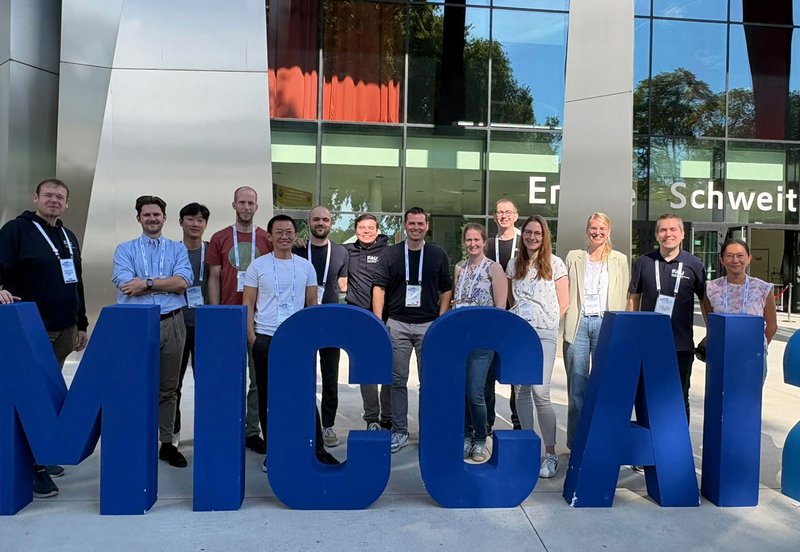
MICCAI is about more than scientific contributions and technological innovation. Personal exchange with researchers, companies, and partners from the international medical imaging community is an equally important part of the conference. Strasbourg provided numerous opportunities to discuss new developments, potential collaborations, and the practical challenges involved in implementing medical AI.
One particularly special moment was reconnecting with former colleagues from the Pattern Recognition Lab at FAU Erlangen-Nürnberg during an alumni gathering. For our CEO, Dieter Hahn, it was an opportunity to reconnect with his time at the chair headed by Prof. Joachim Hornegger – and to see how long-standing research relationships continue to evolve.
From Data to Clinical Applications
MICCAI 2026 in Strasbourg once again made clear how quickly medical imaging and surgical AI are advancing. Progress spans the entire path from processing and annotating complex image and video data to developing specialized AI models and deploying them directly at the point of use.
For Chimaera, one key takeaway remains clear: progress in medical AI does not come from better models alone. It depends on the combination of high-quality data, reliable annotations, well-designed workflows, secure infrastructure, and implementation that reflects the actual requirements of clinical practice.
The TIGER SQ-AI Challenge and the discussions surrounding on-device intelligence illustrate two sides of the same development: AI is becoming more capable, while also needing to move closer to real-world data, concrete workflows, and the point of care.
We therefore leave Strasbourg not only with new impressions, but also with many starting points for further discussions and joint projects.